Your security software should not be allowed to guess at 3 a.m.
Your AI tools may watch, sort, and draft. A person approves anything that disconnects, deletes, or locks people out.
Most organizations under a few hundred people have no security team. They have one person who already has three other jobs, and a stack of paid tools that now advertise automated response.
This campaign argues for one written rule before those tools are switched on: automated systems may collect data, rank alerts, and draft a containment plan, but a named human confirms anything that touches production. That boundary costs nothing to adopt. It also prevents the failure that actually hurts small organizations: a defensive tool that acts on a false alarm and causes the outage itself.
Get the rule cardOne page, printable, black and white. Free, no sign-up.
Three pieces, three audiences
The rule card
A one-page containment policy for the person who runs IT as a side job. Includes a clause to paste into your own policy.
The video
Ninety seconds on how a false alarm becomes an outage, and the one rule that prevents it.
The evidence
The research behind the claim, in three parts, with citations.
Why this is not a vendor problem
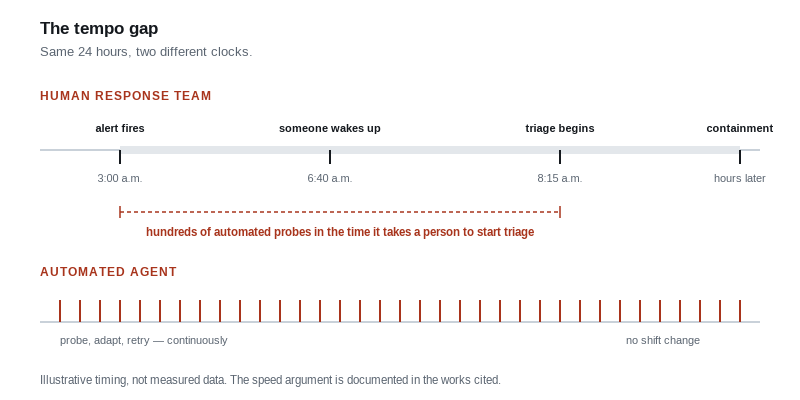
The tools are not the villains. Automated triage is faster than a person reading logs, and the research shows large reductions in triage time. The problem is that vendors sell speed without saying where the tool's authority ends. When a security agent is allowed to isolate a server on its own judgment, every false positive becomes an outage decision made by software that cannot see the business underneath the machine.
A smaller organization has less margin for that error than a bank does. There is no second site, no overnight staff, and no recovery team. That is why the rule is written for the smallest operator rather than the largest one.
What this campaign does not do
- It does not sell, recommend, or evaluate any security product.
- It does not claim that automation is unsafe or that AI cannot help.
- It does not promise compliance with any framework or regulation.
It asks for one sentence in a policy document, and a name next to it.
Download the rule card